








Food Allergy Treatment Options

Food Allergy Treatment Options
There is no cure for food allergies. The treatment options for food allergy break down into two categories:
- Emergency treatment for severe symptoms due to an allergic reaction
- Treatments and management plans that help prevent allergic reactions
On this page:
Epinephrine for emergency treatment
Allergen avoidance (removing food from diet)
Food oral immunotherapy (OIT)
Omalizumab (Xolair® or Omlyclo®)
Epicutaneous immunotherapy (EPIT)
Definitions and pronunciations to help you read and talk about these options:
- Allergen [ah-ler-jin]: thing that causes allergic reaction (like food)
- Anaphylaxis [anna-fih-LACK-sis]: a severe allergic reaction that needs prompt treatment with epinephrine
- Epinephrine [eh-puh-neh-fruhn]: a prescription medicine that treats anaphylaxis
- Immunoglobulin E[ih-myoo-no-GLAH-byoo-lun ee] or IgE for short: an antibody your immune system makes to attack allergens and is what triggers allergic reactions
- Oral immunotherapy [ih-myoo-no-theh-ruh-pee]: a treatment that involves eating a small amount of food allergen to help the immune system learn to tolerate the food
- Omalizumab [oh-muh-liz-uh-mab]: a prescription injection (shot) that works by blocking an immune response to food to help prevent severe allergic reactions if a person accidentally eats their allergen
- Xolair [ZOH-lair]: a brand name for omalizumab
- Omlyclo [ahm-lih-cloh]: an interchangeable biosimilar to Xolair
- Eosinophilic esophagitis [EE-oh-sin-oh-FILL-ick uh-sof-uh-JIE-tis]: a delayed type food allergy that causes swelling in the esophagus (part of your throat)
- Epicutaneous immunotherapy [eh-pih-kyoo-tay-nee-us ih-myoo-no-theh-ruh-pee]
Epinephrine for Emergency Treatment of Severe Allergic Reactions
Epinephrine is the first-line treatment for anaphylaxis, a severe allergic reaction.1 It is the only medication that can stop severe allergic reactions.
Epinephrine comes in easy-to-use options to give the medicine to yourself or child. It is only available through a prescription from your doctor.1 If you or your child have classic food allergies, you need to always have epinephrine quickly and easily available.
Resources:
Food Allergy Emergency Care Plan
This action plan guides what to do if you or your child are having symptoms of a serious allergic reaction.
Epinephrine Options for Treating Severe Allergic Reactions
This decision aid explains the available choices to help you decide which form of epinephrine is best for you.
Long-Term Management of Food Allergies
Currently, there are 3 different options to help people lower the chances of having food allergic reactions. And another option is still being studied and not yet approved by the FDA.
What are the current options for managing food allergy?
- Allergen avoidance (remove the food allergen from the diet)
- Food oral immunotherapy (eat small amounts of allergen with allergist’s guidance)
- Omalizumab injections (a medicine that helps block allergic reactions)
For all of these options, you (or your child) will still need to carry epinephrine and have it with you in case of emergency. Do not try any type of food allergy treatment at home without talking with your allergist.
It’s important to know the benefits, risks, and requirements of each of these treatment options. This information can help you make a decision about which path is right for you.
 Managing Your Child’s Food Allergies |
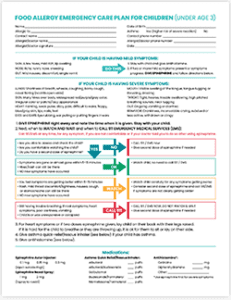 Food Allergy Emergency Care Plans for Children: Available for children under 3, children 3 and up, and translated in 12 languages |
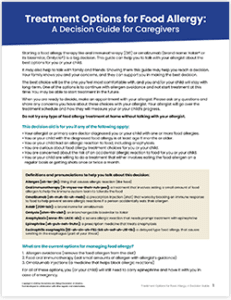 Treatment Options for Food Allergy: A Decision Guide for Caregivers |
Managing Your Child’s Food Allergies
Food Allergy Emergency Care Plans for Children:
Available for children under 3, children 3 and up, and translated in 12 languages
Treatment Options for Food Allergy: A Decision Guide for Caregivers
Food Oral Immunotherapy (OIT): Building Tolerance for the Food Allergen
Food oral immunotherapy (OIT) is a food allergy treatment that re-trains your immune system to respond differently to food. OIT helps the body gradually desensitize (tolerate) a food allergen. It does this by slowly raising the threshold amount of food allergen you can eat before it triggers an allergic reaction.3
Successful treatment of OIT may provide “bite protection.” This means a lower chance of having an allergic reaction if someone accidentally eats a small amount of their food allergen. Some people may even be able to eat the food freely in their diet after reaching the final stage of OIT treatment program.3,4
Most people have results within 6 to 12 months, with regular visits every few weeks to safely increase the dose, followed by routine follow-up visits. OIT works very well in young children, but it is less clear how well it works in adults.3
OIT can lower the chances of a severe reaction if a food allergen is accidentally eaten. However, side effects such as stomach aches, nausea, and vomiting are common during treatment. OIT can also cause anaphylaxis. Although it is uncommon, some people may have eosinophilic esophagitis, a delayed type of food allergy that causes swelling in the esophagus (part of your throat).3 Mild side effects can be treated and get better with time without stopping OIT, but severe side effects may need epinephrine and stopping the treatment. You will still need to avoid other sources of the allergen. If doses are missed for too long, the protection gained from OIT may drop, and stopping treatment for months may cause you to lose the protection.
Omalizumab (Xolair® or Omlyclo®)
Omalizumab is a type of treatment called a biologic. It works by blocking the action of specific molecules that trigger allergic reactions.5 Brand names for this treatment include Xolair and Omlyclo.
Xolair works by attaching itself to the immunoglobulin E (IgE) antibodies to help prevent an allergic reaction. It is an anti-IgE medicine. It reduces your child’s chance of having a food allergy reaction, including anaphylaxis, if your child accidentally eats one of their food allergens.5
Xolair is an injectable treatment that gradually helps raise the amount of a food allergen you or your child can tolerate. Most people notice improvement in their food allergy after about 4 to 5 months, and even better results over longer use. After the first doses are given in the clinic, many people can give the shots at home, with routine follow‑up visits to track progress. Side effects are usually mild, such as redness or swelling at the injection site or occasional fever, though anaphylaxis can occur, especially early in treatment. If you take Xolair, you will still need to avoid the food allergen and carry epinephrine. If doses are missed or treatment is stopped, the protection goes away over a few months.5
Omlyclo (omalizumab-igec) is a biosimilar to Xolair. This means it is very similar, works just as well, is just as safe and effective, and can be used in place of Xolair when needed.6
Epicutaneous Immunotherapy (EPIT)
Epicutaneous immunotherapy (EPIT) is a needle‑free, patch‑based treatment that exposes your or your child’s immune system to small amounts of a food allergen through the skin. The allergen is absorbed into the outer layer of the skin. Because this layer doesn’t have blood vessels, the allergen stays local, allowing your body to learn to tolerate it.7,8 EPIT is still being studied in clinical trials and is not approved by the FDA.
EPIT shows encouraging results, especially in children, by helping the immune system become less reactive to certain food allergens over time. A longer treatment with EPIT is associated with better allergen tolerance, but also with the occurrence of more adverse reactions. Most reactions associated with the use of EPIT are mild to moderate, but there is risk of anaphylaxis. Researchers are still learning how EPIT affects daily life and how well it works for different food allergies. Researchers also continue to weigh its potential benefits against the risk of side effects, especially for young children and people with a history of severe allergic reactions.8
Which Food Allergy Treatment Is Best?
Starting a food allergy therapy is a big decision. The best choice for your food allergy treatment will be the one you feel most comfortable with, and you and/or your child will stay with long-term. One of the options is to continue with allergen avoidance and not start treatment at this time. You may be able to start treatment in the future. When you are ready to decide, make an appointment with your allergist. Do not try any type of food allergy treatment at home without talking with your allergist.
For all of these treatment options, you (or your child) will still need to carry epinephrine and have it with you in case of emergency. AAFA’s Food Allergy Anaphylaxis Action Plan provides information and instructions on how to manage an allergic reaction.
For more information about food allergy treatment please review AAFA’s Food Allergy Treatment Decision Aid. It can help you to talk with your allergist about the best options for you or your child.
Medical Review: Med Communications, Inc. assisted with development and review of medical content. June 2026.
Editorial review: Melanie Carver, AAFA Chief Mission Officer. July 2026.
Closed
References
- Dalal, R., & Grujic D. (2024, November 23). Epinephrine. In StatPearls. StatPearls Publishing. Retrieved July 15, 2026, from: https://www.ncbi.nlm.nih.gov/books/NBK482160/
- Muraro, A., de Silva, D., Halken, S., Worm, M., Khaleva, E., Arasi, S., Dunn-Galvin, A., Nwaru, B. I., De Jong, N. W., Rodríguez Del Río, P., Turner, P. J., Smith, P., Begin, P., Angier, E., Arshad, H., Ballmer-Weber, B., Beyer, K., Bindslev-Jensen, C., Cianferoni, A., Demoulin, C., … GALEN Food Allergy Guideline Group. (2022). Managing food allergy: GA2LEN guideline 2022. The World Allergy Organization Journal, 15(9), 100687. https://doi.org/10.1016/j.waojou.2022.100687
- McHenry, M., Bégin, P., Chan, E. S., Latrous, M., & Kim, H. (2025). Food oral immunotherapy. Allergy, Asthma& Clinical Immunology, 20(Suppl 3), 82. https://doi.org/10.1186/s13223-025-00948-5
- Upton J. E. M. (2022). Efficacy, effectiveness and other patient-centered outcomes of oral immunotherapy. Journal of Food Allergy, 4(2), 28–33. https://doi.org/10.2500/jfa.2022.4.220017
- (2024). Xolair. Prescribing Information. https://www.gene.com/download/pdf/xolair_prescribing.pdf
- Celltrion Inc. (2025). Omlyclo. Prescribing Information. https://www.accessdata.fda.gov/drugsatfda_docs/label/2025/761399s000lbl.pdf
- Xiang, X., Hu, J., Sachu, R., Gao, C., Niu, H., Gao, Y., Chen, S., Cui, X., & Li, X. (2025). Epicutaneous immunotherapy for food allergy: a systematic review and meta-analysis. Systematic Reviews, 14(1), 4. https://doi.org/10.1186/s13643-024-02727-6
- Hervé, P. L., Dioszeghy, V., Matthews, K., Bee, K. J., Campbell, D. E., & Sampson, H. A. (2023). Recent advances in epicutaneous immunotherapy and potential applications in food allergy. Frontiers in Allergy, 4, 1290003. https://doi.org/10.3389/falgy.2023.1290003